Padel vs Pickleball: The Key Differences
Courts, serves, scoring and gear, side by side from the official rulebooks.
Padel is played inside an enclosed court where walls remain in play, while pickleball is played on an open court without walls. At Wildcard Sport, we research official federation rulebooks and equipment standards to map how these two racket sports compare. Neither uses a strung racket, but their courts, balls and scoring differ.
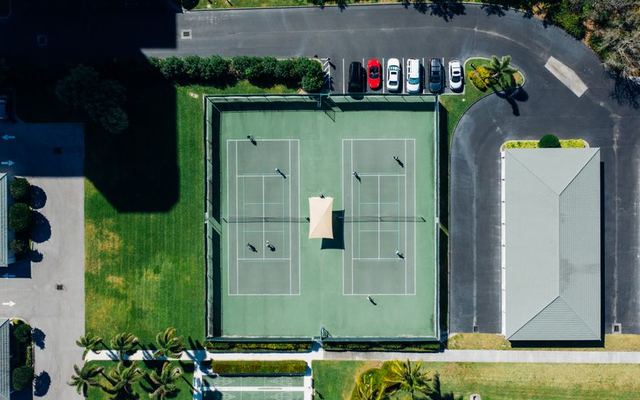
A padel court measures 65.6 by 32.8 feet (20 by 10 meters) and features enclosed walls that keep rebounds active. A pickleball court measures 20 by 44 feet (6.10 by 13.41 meters) on an open surface with a seven-foot non-volley zone near the net. Our sport comparisons examines how court architecture changes competitive play across racket sports.
The Main Differences
The primary difference between padel and pickleball lies in court enclosure and ball physics. Padel's end enclosures stand 13.1 feet (4 m) high, and the ball stays live after it bounces and hits a wall or the mesh. Pickleball's rules have no walls.
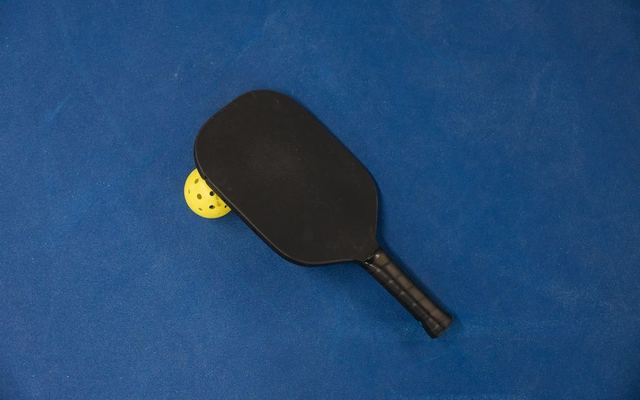
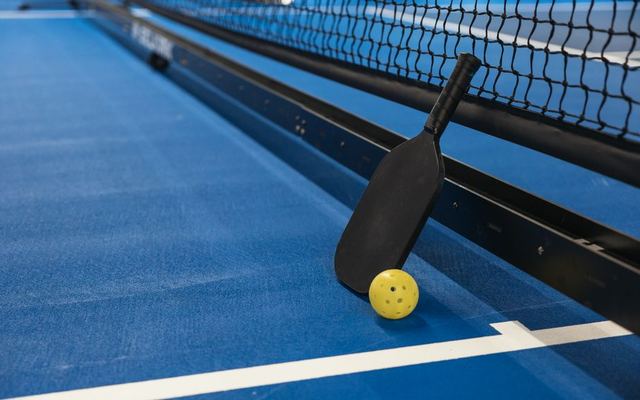
Equipment design reinforces these spatial differences. Padel players use short, thick rackets with perforated faces and hollow rubber balls with a textile cover. Pickleball players use solid paddles without holes and plastic balls with 26 to 40 holes.
The serve rules differ too. Padel requires players to bounce the ball and strike it at or below the waist, sending it diagonally. Pickleball permits either an airborne volley serve or a dropped ball serve into the opposing service box. Pickleball rules also enforce a mandatory two-bounce sequence that delays aggressive net volleys.
Side by Side
Equipment rules and court measurements define how each sport operates under official federation oversight. The International Padel Federation (FIP) Rules of Padel establish global padel regulations, while the USA Pickleball Official Rulebook governs American pickleball standards.
| Feature | Padel | Pickleball |
|---|---|---|
| Court dimensions | 65.6 by 32.8 ft (20 by 10 m) | 20 by 44 ft (6.10 by 13.41 m) |
| Total court area | 2,153 sq ft (200 m²) | 880 sq ft (81.8 m²) |
| Enclosure structure | Fully enclosed (9.8 ft wall plus 3.3 ft mesh at ends) | Open court without walls |
| Wall play | Live after ground bounce, or off own wall | No walls exist |
| Net height at center | 34.6 in (0.88 m) | 34 in (0.86 m) |
| Net height at sidelines | 36.2 in (0.92 m) | 36 in (0.91 m) |
| Non-volley zone | None (service line is 22.8 ft / 6.95 m from net) | 7 ft (2.13 m) adjacent to net |
| Serve execution | At or below waist after a bounce | Volley serve or drop serve |
| Serve bounce rule | Required on every serve | Optional (allowed on drop serve) |
| Net cord on serve | Let replay if ball lands in service box | Live if ball clears non-volley zone |
| Scoring system | Tennis scoring (15, 30, 40, game) | Side-out scoring (rally scoring provisional) |
| Standard match length | Best of 3 sets to 6 games | Games to 11 (win by 2) |
| Competition format | Pairs (doubles) under FIP rules | Singles and doubles on same court |
| Maximum implement length | 17.9 in (45.5 cm) | 17 in (43.18 cm), max 24 in total length plus width |
| Implement face perforations | Mandatory (0.35 to 0.51 in / 9 to 13 mm holes in center) | Prohibited (solid surface without holes) |
| Safety wrist cord | Mandatory non-elastic cord (max 13.8 in / 35 cm) | No cord rule in USA Pickleball's paddle specs |
| Ball core and covering | Hollow rubber core with textile cover | Plastic with 26 to 40 holes |
| Ball diameter | 2.50 to 2.67 in (6.35 to 6.77 cm) | 2.87 to 2.97 in (7.29 to 7.54 cm) |
| Ball weight | 1.98 to 2.10 oz (56.0 to 59.4 g) | 0.78 to 0.935 oz (22.1 to 26.5 g) |
| Bounce test standard | 53.15 to 57.09 in from 100 in drop | 30 to 34 in from 78 in drop |
| US players (2025, Sports & Fitness Industry Association data) | 1.073 million | 24.3 million |
| Pick it if | An enclosed court is near you and you play doubles | You want singles or a court less than half the size |
Court Size and Walls
A padel court covers about 2.4 times the area of a pickleball court. An official padel court measures 65.6 feet long by 32.8 feet wide (20 by 10 meters) inside its perimeter. This creates an overall playing surface of 2,153 square feet (200 square meters), with a 0.5 percent construction tolerance allowed by FIP rules.
A standard pickleball court measures 20 feet wide by 44 feet long (6.10 by 13.41 meters). This boundary yields an area of 880 square feet (about 81.8 square meters). You can explore exact layout specifications in our padel court dimensions guide.
Enclosure rules create the defining physical contrast between the two games. FIP regulations state that a padel court must be completely enclosed by walls and metallic mesh. The end enclosures reach 13.1 feet (4 m) in total height, formed by a 9.8-foot (3 m) wall topped by a 3.3-foot (1 m) metal fence.
Padel walls are active playing elements rather than boundary barriers. If a ball bounces in the opponent ground and strikes a wall or mesh, it remains live until a second ground bounce. Under FIP Rule 14b, a player may also strike the ball against a wall on their own side so it crosses the net.
Pickleball features no walls or physical enclosures in its rules. Pickleball courts also incorporate a distinct seven-foot non-volley zone adjacent to each side of the net. Players cannot strike the ball out of the air while contacting this non-volley zone surface. Readers researching court layouts can compare options across other sports like pickleball.
Net Height
Net heights in padel and pickleball are nearly identical despite the difference in court dimensions. A padel net is 32.8 feet (10 m) long. It stands about 34.6 inches (0.88 m) high at the center and rises to about 36.2 inches (0.92 m) at the ends, with a tolerance of 0.2 inches (0.005 m).
Pickleball regulations set the center net height at 34 inches (0.86 meters). The net rises to 36 inches (0.91 meters) at the outer sidelines. USA Pickleball allows a variance of 0.25 inches above or below these dimensions.
Padel nets are only 0.6 inches higher than pickleball nets at the midpoint. At the sidelines, padel nets sit approximately 0.2 inches higher than pickleball nets.
Serving
Both sports cap the serve at waist height: padel on every serve, pickleball on its volley serve. Padel requires the server to bounce the ball and strike it after the bounce. The ball must travel diagonally across the net and land inside the receiver service box.
Padel service lines sit about 22.8 feet (6.95 m) from the net, and the central service line splits that area into two service boxes. Servers must keep at least one foot on the ground during ball contact. If the first delivery fails, padel rules grant the server a second serve attempt.
Pickleball offers two distinct legal serving mechanics under official rules. A volley serve requires an upward paddle arc, with the paddle head below the wrist and contact below the waist. Alternatively, players may execute a drop serve by dropping the ball and striking it after it bounces. The serve must clear the opponent seven-foot non-volley zone and land inside the diagonal service court.
Net cords on the serve receive different treatments under current regulations. Under FIP rules, a padel serve that touches the net and lands in the service box is called a net and replayed. If that let serve strikes the metallic mesh before its second bounce, it counts as a fault.
In contrast, the 2026 USA Pickleball Official Rulebook Rule 7.E states that a serve remains live if it touches the net and lands in the correct court. Pickleball rules also enforce a two-bounce sequence after the serve. The receiving team must let the serve bounce before returning, and the serving team must let that return bounce before playing it. You can read comprehensive stroke regulations in our padel rules guide.
Scoring
Padel uses traditional tennis scoring with numerical increments of 15, 30, and 40. A game tied at 40-40 is called deuce. FIP regulations outline three official methods for resolving a deuce score.
Option 1 requires an Advantage point, where a pair must win two consecutive points from deuce to claim the game. Option 2 uses a Star Point format. Option 3 applies a Golden Point, where a single sudden-death point decides the game at deuce without an advantage sequence.
Padel sets are won by the first pair to reach six games with a two-game advantage. If the score reaches 6-6, players enter a tie-break to determine the set winner. Matches follow a best-of-three-sets structure.
The FIP rules are written for pairs. Review our padel scoring breakdown for detailed set mechanics.
Standard pickleball scoring awards points only to the team currently serving the ball. Under this side-out method, games are normally played to 11 points, with victory requiring a two-point margin. Tournament organizers may schedule games to 15 or 21 points under USA Pickleball tournament guidelines.
Rule 14.A also lists rally scoring as a provisionally approved option, where every rally awards a point regardless of who served. Pickleball functions as both a singles and doubles sport using the exact same 20 by 44 foot court dimensions.
Rackets vs Paddles
A padel racket may not exceed about 17.9 inches (45.5 cm) in total length across handle and head. FIP rules limit head width to 10.2 inches (26 cm) and thickness to 1.5 inches (38 mm).
The hitting surface must have holes 0.35 to 0.51 inches (9 to 13 mm) across in the central area. Both faces must be flat. Every padel racket must also incorporate a non-elastic safety wrist cord measuring no more than 13.8 inches (35 cm).
FIP regulations state that wearing this wrist cord is obligatory during play. Compare racket specifications in our padel rackets guide.
Pickleball paddles operate under different dimensional and surface restrictions. The USA Pickleball Equipment Standards Manual caps paddle length at 17 inches (43.18 centimeters). The combined length and width cannot exceed 24 inches (60.96 centimeters), including the edge guard and butt cap.
Pickleball paddles have no restrictions on thickness or weight. However, the striking face must be solid. USA Pickleball explicitly prohibits holes, rough texturing, or rubber on the paddle surface. Pickleball paddles may not have holes, and padel rackets must, so neither is legal in the other sport.
The Balls and How They Bounce
Padel balls are rubber spheres with a hollow rubber inner core and an outer textile cover. According to the FIP ball technical specification, the covering blends cotton, wool, and nylon fibers.
Standard padel balls may be pressurized or pressureless under official rules. They weigh between 1.98 and 2.10 ounces (56.0 to 59.4 grams) and measure 2.50 to 2.67 inches (6.35 to 6.77 centimeters) in diameter. When dropped from 100 inches (2.54 meters) onto a hard surface, a padel ball must rebound between 53.15 and 57.09 inches (135 to 145 centimeters).
FIP specifies an internal pressure between 4.6 kilograms and 5.2 kilograms per 2.54 square centimeters. Learn about ball construction standards in our padel balls overview and our comparison of padel vs tennis.
Pickleball balls are plastic balls with holes. Official balls weigh between 0.78 and 0.935 ounces (22.1 to 26.5 grams). Their diameter ranges from 2.87 to 2.97 inches (7.29 to 7.54 centimeters).
Equipment standards require between 26 and 40 circular holes across the surface. Balls with larger holes are customarily used indoors, while models with smaller holes are used outdoors. When dropped from 78 inches onto a granite plate, a pickleball must bounce between 30 and 34 inches.
A padel ball weighs more than twice as much as a pickleball: at least 1.98 ounces against at most 0.935 ounces.
How Many Play, and Finding Courts
Pickleball has far more US players than padel. A report released June 4, 2026, by the Sports & Fitness Industry Association (SFIA) recorded 24.3 million Americans playing pickleball in 2025. That participation figure grew from 4.2 million players in 2020.
SFIA identified 7.5 million core players who played pickleball eight or more times during 2025. Reporting from Pickleball.com notes that total pickleball participation jumped 22.8 percent in 2025 compared to 2024.
Padel starts from a much smaller base in the United States. According to a United States Padel Association (USPA) announcement citing the SFIA 2026 Topline Participation Report, 1,073,000 Americans played padel in 2025. Of that total, 238,000 participants played eight or more times as core players.
USPA records show just over 1,000 padel courts operating across 31 US states as of April 2026. The organization projects building toward 10,000 courts and reaching more than 10 million players by 2030.
The 2025 data shows roughly 23 pickleball players for every padel player in the United States. Readers evaluating court access can also review our comparison of pickleball vs tennis.
Which Should You Play?
Pick pickleball if no padel court is near you or if you want singles. USA Pickleball's rules cover singles and doubles on the same court, while the FIP rules are written for pairs.
Pickleball is not the right fit for players seeking full-court movement with wall rebounds. If you want a game that mirrors tennis scoring and encourages shots off enclosure walls, choose padel. In padel, a defender can still return a ball after it comes off the back wall.
Local facility access would immediately change our recommendation. If your city lacks a dedicated padel club among the 1,000 existing US courts, pickleball is your default path. Find a court with our court-finding guide, then play one session of each to compare the two yourself.
Frequently Asked Questions
What is the difference between padel and pickleball?
Padel is played on an enclosed 65.6 by 32.8 foot (20 by 10 m) court where balls can come off the walls. Pickleball is played on an open 20 by 44 foot court. Padel uses perforated stringless rackets and felted rubber balls, whereas pickleball uses solid paddles without holes and perforated plastic balls. Padel matches follow tennis scoring in doubles pairs, while pickleball uses side-out scoring up to 11 points for singles or doubles.
Is padel harder than pickleball?
No rulebook ranks padel or pickleball by difficulty. Padel keeps the ball live off its walls on a 2,153 square foot court. Pickleball bans volleys in a seven-foot zone on an 880 square foot court and adds a two-bounce rule.
Is a padel court bigger than a pickleball court?
A padel court is about 2.4 times larger than a pickleball court in total surface area. Padel courts measure 65.6 by 32.8 feet (20 by 10 meters) for a total of 2,153 square feet (200 square meters). Pickleball courts measure 20 by 44 feet (6.10 by 13.41 meters) for an area of 880 square feet (about 81.8 square meters).
Can you use a pickleball paddle for padel?
You cannot use a pickleball paddle for padel under official equipment regulations. FIP rules require padel rackets to feature perforated holes across the central hitting area and an obligatory safety wrist cord. USA Pickleball rules prohibit holes in paddle faces, making each implement illegal in the opposing sport.
Is the net the same height in padel and pickleball?
The nets in padel and pickleball are nearly identical in height. Padel nets measure 34.6 inches (0.88 meters) at the center and 36.2 inches (0.92 meters) at the ends. Pickleball nets measure 34 inches at the center and 36 inches at the sidelines, creating a center height difference of only 0.6 inches.
Is the scoring the same in padel and pickleball?
Scoring systems differ substantially between the two sports. Padel uses traditional tennis scoring of 15, 30, 40, and game, played across sets of six games with a tie-break at 6-6. Pickleball uses side-out scoring where only the serving side scores, with games normally to 11 points and a two-point margin.
Can you play off the walls in pickleball?
You cannot play off the walls in pickleball because the official rulebook defines an open court without enclosures. In padel, walls are fully integrated into play, allowing balls to be returned after striking the perimeter walls.