Padel vs Tennis: The Key Differences
Court size, the waist-height serve and scoring, side by side from the rulebooks.
Padel and tennis share scoring roots, but padel uses an enclosed court with active walls, waist-level bounce serves, and stringless perforated rackets. At Wildcard Sport, we evaluate federation rulebooks and equipment standards to separate genuine play differences from surface-level comparisons. Tennis uses an open court, strung rackets up to 29.0 inches (73.7 cm) long, and overhead serves hit before the ball bounces.
The Lawn Tennis Association (LTA) notes that both games score points the same way. You can compare other racket sports in our padel comparison hub or review equipment differences in our padel ball vs tennis ball guide.
The Main Differences
The core difference between padel and tennis lies in court geometry and boundary rules. Tennis is played on an open court, and the ITF lists backstops and sidestops as permanent fixtures. Padel is played inside a fully enclosed court where walls keep the ball active.
In padel, the ball can strike the walls after hitting the ground in the opponent's court. Players can let a ball rebound off the enclosure before returning it. They can also hit the ball directly into their own wall so that it travels over the net.
Serve mechanics also separate the sports. In tennis, players toss the ball into the air and hit it before it touches the surface. In padel, players must bounce the ball on the court surface and strike it at or below waist height.
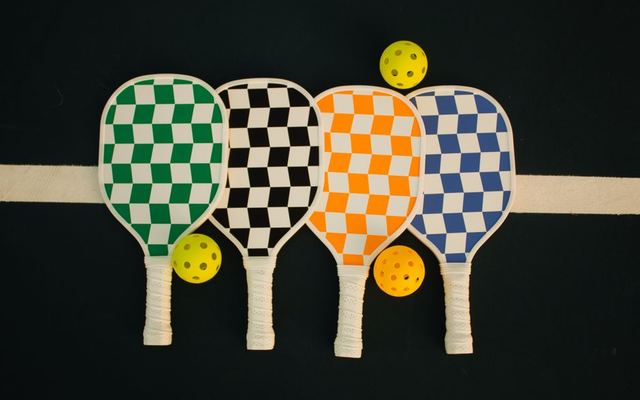
Tennis rackets have a pattern of crossed strings. Padel rackets have no strings and a perforated hitting surface.
You can inspect the full rule set for padel in our padel rules overview. If you want to explore other racket sports, see our guides to platform tennis and beach tennis.
Side by Side
The table below contrasts official standards from the International Padel Federation (FIP) and the International Tennis Federation (ITF).
| Rule or Specification | Padel (FIP) | Tennis (ITF) |
|---|---|---|
| Court length | 65.6 ft (20 m) | 78.0 ft (23.77 m) |
| Court width | 32.8 ft (10 m) | 27.0 ft (8.23 m) singles, 36.0 ft (10.97 m) doubles |
| Court area | 2,153 sq ft (200 m²) | 2,807 sq ft (260.8 m²) doubles |
| Court enclosure | Fully enclosed (13.1 ft ends, stepped sides) | Open court |
| Enclosure walls in play | Yes (rebound allowed after ground bounce) | No walls; backstops are permanent fixtures |
| Permitted surface types | Cement, synthetic material, or artificial grass | Not covered by our sources |
| Net height at center | 34.6 in (0.88 m) | 36.0 in (0.914 m) |
| Net height at posts or ends | 36.2 in (0.92 m) | 42.1 in (1.07 m) |
| Service line distance from net | 22.8 ft (6.95 m) | 21.0 ft (6.40 m) |
| Serve contact rule | At or below waist level | Struck before ball touches ground |
| Serve bounce | Required (ball bounces first) | Prohibited (struck in the air) |
| Foot position at serve | At least one foot on ground | One or both feet may leave ground |
| Second serve allowed | Yes | Yes |
| Deuce format options | Advantage, Golden Point, or Star Point | Advantage or No-Ad |
| Set format | 6 games by 2; tie-break at 6 to 6 | Advantage Set or Tie-break Set (at 6 to 6) |
| Match format | Best of 3 sets | Best of 3 or best of 5 sets |
| Player format | Doubles-only (per LTA) | Singles and doubles |
| Racket maximum length | 17.9 in (45.5 cm) | 29.0 in (73.7 cm) |
| Racket hitting surface | Perforated, stringless face | Crossed woven strings |
| Mandatory safety cord | Yes (non-elastic, max 13.8 in / 35 cm) | No cord rule in our sources |
| Ball diameter | 2.50 to 2.67 in (6.35 to 6.77 cm) | 2.57 to 2.70 in (6.54 to 6.86 cm) Type 2 |
| Ball weight | 1.98 to 2.10 oz (56.0 to 59.4 g) | 1.98 to 2.10 oz (56.0 to 59.4 g) Type 2 |
| Ball rebound height | 53.1 to 57.1 in (135 to 145 cm) | 53.1 to 57.9 in (135 to 147 cm) Type 2 |
| United States players in 2025 | 1,073,000 (United States Padel Association) | 27,300,000 (United States Tennis Association) |
| Pick it if | You play doubles and have an enclosed court nearby | You want singles or an overhead serve |
Court Size and Walls
Court boundaries define the movement patterns of both sports. A padel court measures 65.6 feet (20 m) long by 32.8 feet (10 m) wide, measured inside the playing area. FIP allows a 0.5 percent construction tolerance.
A regulation tennis court measures 78.0 feet (23.77 m) long. The width is 27.0 feet (8.23 m) for singles matches and 36.0 feet (10.97 m) for doubles matches.
The arithmetic reveals a distinct size gap. A padel court covers 200 square meters (2,153 sq ft). A tennis doubles court covers 260.8 square meters (2,807 sq ft).
A padel court is roughly 77 percent of the lined area of a doubles tennis court. It is also 12.4 feet (3.77 m) shorter from end to end. You can review detailed specifications in our padel court dimensions guide.
The court perimeter creates an even larger mechanical difference. Padel rules mandate that the court must be completely enclosed.
The end enclosures must stand 13.1 feet (4 m) high. This consists of 9.8 feet (3 m) of wall topped by 3.3 feet (1 m) of metal fence. Side enclosures combine stepped walls and metal mesh across two approved layout options.
The walls remain live during rallies. Once a ball bounces on the court surface, it may strike the wall or fence and remain playable before a second bounce. The ITF lists backstops and sidestops as permanent fixtures of a tennis court under Rule 2.
Surface options also diverge. FIP allows cement, synthetic material, or artificial grass. FIP lists green, blue, and terracotta as preferred colors.
Net Height
Net heights look similar at the center strap, but post clearances vary. In padel, the net measures 34.6 inches (0.88 m) high at the center. It rises to 36.2 inches (0.92 m) at the outer ends.
A tennis net measures 3.0 feet (0.914 m) at the center strap. The net cord passes over the posts at 3.5 feet (1.07 m).
The center net height difference is modest. Padel is 1.3 inches (3.4 cm) lower in the middle than tennis.
The edges create a wider gap. Padel net ends sit 5.9 inches (15 cm) lower than tennis net posts.
Service lines also change court spacing. A padel service line sits 22.8 feet (6.95 m) from the net. A tennis service line sits 21.0 feet (6.40 m) from the net.
The padel service box is therefore 1.8 feet (0.55 m) longer than the tennis service box.
Serving
The two sports serve in opposite ways. Tennis permits overhead serves. Padel requires a ground bounce and a contact point at or below waist height.
In tennis, the server stands behind the baseline. They toss the ball by hand and hit it before it touches the surface. ITF Rule 18, Case 2 explicitly allows the server to have one or both feet off the ground during contact.
Padel enforces strict contact limits under FIP regulations. The server stands behind the service line and must bounce the ball before hitting it. Contact must occur at or below waist height.
Footwork rules differ as well. Padel requires the server to keep at least one foot on the ground at the moment of contact. Jumping into the serve is illegal.
Both sports give the server two chances to land the ball in the diagonally opposite box. However, padel adds a specific enclosure fault.
If a padel serve bounces in the service box and touches the metal fence before its second bounce, it is an immediate fault.
The LTA summarizes the padel delivery as an underarm serve hit after one bounce. FIP rule text does not use the word underarm, relying instead on the strict waist-height test.
Scoring and Deuce
Basic point scoring follows the same path in both sports. Points advance from 15 to 30 to 40 and game. The LTA notes that both tennis and padel score in the same way.
Sets run to 6 games, won by a 2-game margin. If a set reaches 6 to 6, players contest a tie-break. Matches are best of three sets in padel, while tennis allows best of three or best of five sets.
Differences appear in the available deuce variations. Standard tennis relies on advantage scoring, requiring a player to win two consecutive points from deuce. The ITF also permits a No-Ad format under Appendix VI, where the next point decides the game.
FIP provides three distinct deuce options for tournament play. Organizers may choose Advantage, Golden Point, or Star Point.
Golden Point functions like No-Ad. When the score reaches 40 to 40, players contest a single deciding point.
Star Point introduces a third path. Players contest deuce and advantage two consecutive times. If the score returns to deuce a third time, a single deciding Star Point settles the game.
You can study each format in detail in our padel scoring guide.
Rackets and Balls
Rackets and balls feature distinct physical limits under their respective federations. Padel rackets have no strings. Tennis rackets have a pattern of crossed strings.
FIP limits padel racket length to 17.9 inches (45.5 cm). The head width cannot exceed 10.2 inches (26 cm), and thickness cannot exceed 1.5 inches (38 mm).
The striking surface of a padel racket is solid and perforated with holes 0.35 to 0.51 inches (9 to 13 mm) across in the center. FIP also mandates a non-elastic safety wrist cord with a maximum length of 13.8 inches (35 cm).
The ITF permits tennis rackets an overall length up to 29.0 inches (73.7 cm) and a width up to 12.5 inches (31.7 cm).
By maximum dimensions, a padel racket is about 62 percent the length of a tennis racket. You can compare frame designs in our padel rackets guide.
Balls share weight standards but diverge in size and bounce. Both padel and tennis Type 2 balls must weigh between 56.0 and 59.4 grams (1.98 to 2.10 oz).
Diameter ranges differ slightly. Padel balls measure 2.50 to 2.67 inches (6.35 to 6.77 cm). Tennis Type 2 balls measure 2.57 to 2.70 inches (6.54 to 6.86 cm).
Padel's allowed diameter range starts smaller than tennis. Rebound tolerances also differ when dropped from 100 inches (2.54 m) onto a hard surface.
Padel balls must rebound between 53.1 and 57.1 inches (135 to 145 cm). Tennis Type 2 balls must rebound between 53.1 and 57.9 inches (135 to 147 cm).
The LTA notes that padel balls are slightly less pressurised than tennis balls. As a result, they bounce lower and fly slower.
Which Is Easier to Learn
Player format creates an immediate split in participation options. The LTA states that padel is doubles-only, while tennis can be played as singles or doubles.
The LTA also reports that padel is generally considered easier to learn than tennis. The governing body attributes this to the smaller court, the waist-height bounce serve, and lower ball speed.
The LTA identifies the wall as the biggest difference between the two sports.
Padel is not for you if you want singles, because the LTA describes padel as doubles-only. Tennis is played as singles or doubles.
Padel is also a poor fit if you want an open court, since FIP requires the padel court to be completely enclosed.
Our verdict would change if the FIP published singles rules, because the doubles-only format is the main reason we send singles players to tennis.
How Many Americans Play
Tennis and padel participation are counted by different US organizations.
On February 18, 2026, the United States Tennis Association (USTA) published participation figures for 2025. US tennis participation reached 27.3 million players, growing by 1.6 million people.
That marked tennis's sixth consecutive year of net growth. The USTA identified 14.5 million core players who took the court 10 or more times. First-time players accounted for 4.9 million participants.
On April 13, 2026, the United States Padel Association (USPA) reported that 1,073,000 Americans played padel in 2025.
Core padel players totaled 238,000, defined as playing 8 or more times in the year. The USPA documented just over 1,000 padel courts spread across 31 states as of April 2026.
The scale gap remains substantial. Tennis participation in the United States is more than 25 times larger than padel.
The definition of a core player also varies across reports. Tennis measures participation at 10 or more sessions per year, while padel data measures 8 or more sessions.
Find a court with our court-finding guide and play one padel match to compare the two yourself.
Frequently Asked Questions
Is padel easier than tennis?
The LTA states that padel is generally considered easier to learn than tennis. The LTA links this to the smaller court, the underarm serve and the slower ball.
Is padel harder than tennis?
Padel is not considered harder to learn than tennis, according to the LTA. The LTA calls the wall the biggest difference between the two sports.
Can tennis players play padel?
Tennis players can play padel, and the LTA notes that both sports share the same core scoring framework. Players must adjust to a stringless racket, an enclosed court, and doubles-only play, as the LTA describes it.
Is padel scored the same as tennis?
Padel uses the same 15, 30, 40, game structure as tennis, with sets played to 6 games. The difference lies at deuce, where FIP allows tournament directors to choose Advantage, Golden Point, or Star Point.
Is a padel court smaller than a tennis court?
A padel court is smaller than a tennis court. It measures 65.6 by 32.8 feet (200 m²), against 78 by 36 feet (260.8 m²) for doubles tennis. A padel court represents about 77 percent of the area of a tennis doubles court.
Can you serve overhand in padel?
You cannot hit an overhead serve in padel. FIP rules require the server to bounce the ball on the surface and strike it at or below waist level while keeping at least one foot on the ground.
Can you use a tennis racket for padel?
You cannot use a tennis racket for padel. Padel rules require a stringless, perforated racket up to 17.9 inches (45.5 cm) long with a mandatory wrist cord. Tennis rackets are strung and may be up to 29.0 inches (73.7 cm) long.