Padel Court Dimensions in Feet and Meters
FIP fixes the size; FIP, SAPCA and the LTA differ on a few details.
An official padel court measures 65.62 feet long by 32.81 feet wide (20.00 by 10.00 meters) inside the enclosure. At Wildcard Sport, we review governing body regulations and engineering guides to document exact playing specifications. The International Padel Federation (FIP) defines these padel court dimensions with an allowed tolerance of 0.5 percent.
Court Size and Total Footprint
A standard doubles court forms a rectangle with an internal area of 2,152.8 square feet (200 square meters). The Lawn Tennis Association (LTA) describes padel as played on an enclosed court about a third of the size of a tennis court. Outdoor courts should run north to south on their long axis, though FIP allows variation between north-northeast and north-northwest.
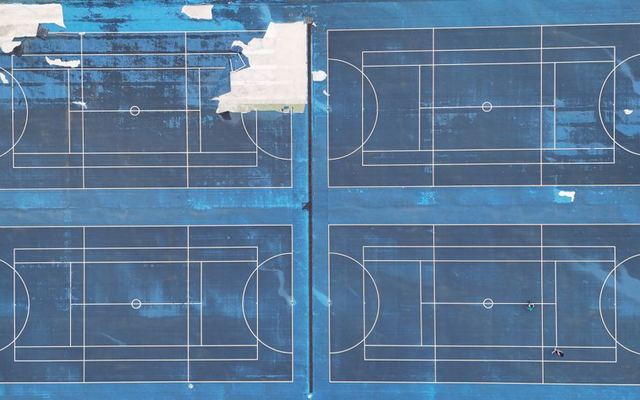
Site footprints require more ground than the playing area alone. The LTA gives a minimum area of 68.24 by 35.43 feet (20.80 by 10.80 meters) for a single external court to include a 15.7-inch (400-millimeter) surface ring beam. If you build two adjacent courts, the footprint widens to 68.24 by 73.16 feet (20.80 by 22.30 meters) with a 4.92-foot (1.50-meter) gap between enclosures.
Four adjacent courts without external play zones require 68.24 by 148.62 feet (20.80 by 45.30 meters). If you plan a facility, check our padel court size guide to calculate the land needed for your layout. You can also explore our overview of padel court requirements before ordering groundworks.
Net Height and Court Lines
The net divides the 65.62-foot (20-meter) court into two equal halves. Per FIP, the net stretches 32.81 feet (10.00 meters) across the playing area. It hangs at a height of 34.6 inches (0.88 meters) at the center and rises to 36.2 inches (0.92 meters) at each post, with a maximum tolerance of 0.2 inches (0.005 meters).
A metal cable no thicker than 0.39 inches (0.01 meters) suspends the net between two lateral posts that stand up to 41.3 inches (1.05 meters) tall. A white strip between 1.97 and 2.48 inches (5.0 and 6.3 centimeters) wide tops the net. Any additional advertising strip cannot be taller than 4.33 inches (11.0 centimeters).
Service lines run parallel to the net at a distance of 22.80 feet (6.95 meters) on each side. A central service line runs perpendicular between the service line and the net to create two equal service boxes per side. All court lines measure 1.97 inches (5 centimeters) wide and are preferably white or black for contrast against the floor.
Sources disagree on how far the central line extends past the service line toward the back wall. FIP rules and the Sports and Play Construction Association (SAPCA) Code of Practice state that the line must extend at least 7.87 inches (20 centimeters). In contrast, the LTA 2025 construction guidance note and older LTA court guidance state that the line crosses over by 3.94 inches (10 centimeters). Name the center-line extension you want (7.87 inches per FIP, 3.94 inches per the LTA) in the line-marking order.
Wall Heights for Each Wall Layout
Every padel court is fully enclosed by solid walls and metal mesh panels. The end walls stand 13.12 feet (4.00 meters) tall, combining 9.84 feet (3.00 meters) of solid wall with 3.28 feet (1.00 meter) of metal fence above it. Solid sections are made of glass, brick or another solid material.
Under the SAPCA Code of Practice, the upper 3.28-foot fence on the end walls uses weldmesh with 1.97 by 1.97 inch (50 by 50 millimeter) openings in 0.12-inch (3-millimeter) or 0.16-inch (4-millimeter) wire. FIP rules require metal fence mesh openings to measure between 1.97 inches (5.00 centimeters) and 2.79 inches (7.08 centimeters) along the diagonal. The recommended wire thickness is 0.08 to 0.12 inches (2 to 3 millimeters), with a 0.16-inch (4-millimeter) limit.
Side walls run 65.62 feet (20.00 meters) in length and follow one of two structural configurations permitted by FIP:
- Variant 1 (Stepped wall): Solid walls at each end stand 9.84 feet (3.00 meters) high for the first 6.56 feet (2.00 meters) of length, then step down to 6.56 feet (2.00 meters) high for the next 6.56 feet (2.00 meters). Metal fencing completes the enclosure, rising to 9.84 feet (3.00 meters) in the central 19.69 feet (6.00 meters) and 13.12 feet (4.00 meters) at both ends.
- Variant 2 (Crystal wall): Solid walls measure 9.84 feet (3.00 meters) high across the entire 13.12-foot (4.00-meter) length from each corner with no step. Metal mesh rises to 13.12 feet (4.00 meters) over the outer 6.56 feet (2.00 meters) of each corner.
On Variant 1 the solid wall steps down after 6.56 feet, while the Crystal variant keeps a full 9.84-foot wall for the first 13.12 feet. Read our guide on padel court surface types to compare artificial grass, cement, and synthetic options permitted under FIP rules.
Ceiling Height for Indoor Courts
FIP mandates a clear height of at least 19.69 feet (6.00 meters) throughout the court. FIP requires the 6 m clear height to be free of anything, such as spotlights, that would obstruct it. For new facilities, FIP suggests a minimum free height of 26.25 feet (8.00 meters).
British standards follow a similar two-tier framework. The SAPCA Code of Practice calls for at least 19.69 feet (6.00 meters) of unobstructed height measured to the underside of overhanging lights, treating 26.25 feet (8.00 meters) as a secondary option where feasible. For covered courts spanning end to end, the LTA specifies at least 19.69 feet (6.00 meters) at the court ends and 26.25 feet (8.00 meters) above the net line. Elite competition needs at least 26.25 feet (8.00 meters) over the net line.
Actual venue clearances in the United States often exceed federation minimums. A Padel Browser survey of 108 US padel clubs reported a minimum ceiling height of 20 feet, a median of 30 feet, and a maximum of 85 feet. Fifteen of those 108 venues fell short of the 26.25-foot (8-meter) recommendation suggested for modern construction.
Doorways and Wheelchair Access
Players enter the court through dedicated openings positioned symmetrically along the long side walls. FIP permits either one or two access openings per side. Each opening must fall within these FIP sizes:
| Access configuration | Minimum dimensions | FIP maximum dimensions | Older LTA datasheet maximum |
|---|---|---|---|
| One access per side | 3.44 x 6.56 ft (1.05 x 2.00 m) | 7.22 x 7.22 ft (2.20 x 2.20 m) | 6.56 x 7.22 ft (2.00 x 2.20 m) |
| Two accesses per side | 2.36 x 6.56 ft (0.72 x 2.00 m) | 3.61 x 7.22 ft (1.10 x 2.20 m) | 3.28 x 7.22 ft (1.00 x 2.20 m) |
The current FIP rules give larger maximums than the older LTA datasheet. The LTA construction note states that sports wheelchair access requires at least 3.94 feet (1.20 meters) of clearance between the net post and the enclosure on each side. Before you hire, read our guide to vetting padel court builders.
Space Around the Court
For out-of-court play, FIP requires two access doors on each side. Obstacles cannot sit within safety corridors around those entrances.
Governing bodies define these safety zones differently:
- FIP specifications: The safety zone must span at least 9.84 feet (3.00 meters) wide, with 13.12 feet (4.00 meters) recommended. It must extend 13.12 feet (4.00 meters) along the wall and maintain a clear height of at least 9.84 feet (3.00 meters).
- SAPCA specifications: The safety zone must measure at least 6.56 feet (2.00 meters) wide and 13.12 feet (4.00 meters) long on each side, with a clear height of at least 13.12 feet (4.00 meters).
The LTA notes that the out-of-court area only needs to be considered where elite level tournaments are planned. For broader financial planning, review our breakdown of what a court costs to build factors.
Singles Courts and Other Unofficial Sizes
Singles courts have no FIP specification, but two padel publications describe them as 65.62 by 19.69 feet (20 by 6 meters). An article by Nick Baker for UK PADEL explains that a singles court maintains the standard 20-meter length while narrowing the width from 10 meters down to 6 meters. Padel Addict also cites this 20 by 6 meter size.
Neither UK PADEL nor Padel Addict cites a federation rule for the 6 m width. According to UK PADEL, the back wall of a singles enclosure uses three 6.56-foot (2-meter) glass panels instead of the five panels found on doubles courts. No FIP specification for singles courts was found regarding net lengths or line layouts.
If your goal is official competitive padel, you should install a standard doubles court. A revision to FIP rules recognizing singles would change these figures. Before pouring footings, compare site measurements against our padel court construction guide to verify foundation sizing and padel court dimensions.
Frequently Asked Questions
What are the dimensions of a padel court in feet?
A standard padel court measures roughly 65.6 feet long by 32.8 feet wide (20.00 by 10.00 meters) on the inside playing area. The back walls stand 13.1 feet (4.00 meters) tall. Indoor courts require a clear overhead height of at least 19.7 feet (6.00 meters), with 26.2 feet (8.00 meters) suggested for new facilities.
How high is a padel net?
A padel net measures 34.6 inches (0.88 meters) high at the center and 36.2 inches (0.92 meters) at the lateral posts. The net spans 32.81 feet (10.00 meters) across the playing surface with an allowed tolerance of 0.2 inches (0.005 meters). Lateral posts holding the net cable cannot exceed 41.3 inches (1.05 meters) in height.
How tall are padel court walls?
The back walls of a padel court reach a total height of 13.12 feet (4.00 meters). This structure comprises 9.84 feet (3.00 meters) of glass, brick or another solid material topped by 3.28 feet (1.00 meter) of metal fence. Side-wall heights depend on which of FIP's two variants the court uses, with metal fence reaching 13.12 feet (4.00 meters) at both ends.
How high does the ceiling need to be for indoor padel?
Indoor padel requires an unobstructed ceiling clearance of at least 19.69 feet (6.00 meters) across the entire court. FIP suggests a clear height of 26.25 feet (8.00 meters) for new construction, and elite competition needs at least 26.25 feet (8.00 meters) over the net line. A survey of 108 US clubs found a median clearance of 30 feet, with a minimum of 20 feet and a maximum of 85 feet.
Is a padel court smaller than a tennis court?
Yes, a padel court is smaller than a tennis court. The LTA describes it as about a third of the size of a tennis court. Its playing area is 65.6 by 32.8 feet (20 by 10 meters).
How big is a singles padel court?
Singles padel courts measure 65.62 feet long by 19.69 feet wide (20.00 by 6.00 meters), according to UK PADEL and Padel Addict. No FIP specification for singles courts was found, so these measurements are unofficial. The back wall on these courts features three 6.56-foot (2-meter) glass panels instead of five.
How much space do you need around a padel court?
A standalone external court needs a minimum area of 68.24 by 35.43 feet (20.80 by 10.80 meters) to accommodate the enclosure and a nominal 15.7-inch (400-millimeter) surface ring beam. For out-of-court play, FIP asks for a clear area at least 9.84 feet (3 m) wide, 13.12 feet (4 m) long and 9.84 feet (3 m) high on each side. SAPCA asks for 6.56 feet (2 m) wide and 13.12 feet (4 m) high, and the LTA says this applies only to elite tournaments.