The Padel Gear You Actually Need
What to bring, what the club supplies, and a priced starter kit.
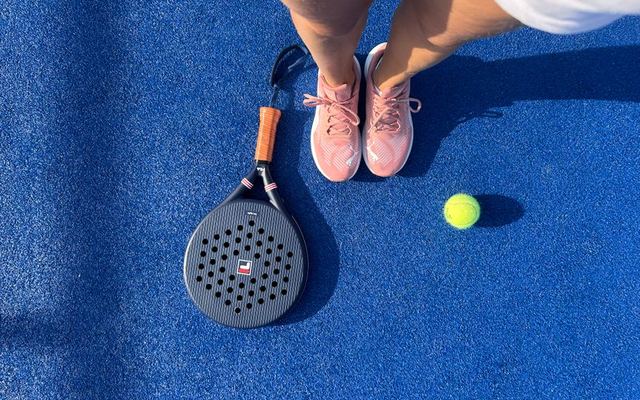
To play padel, you need a regulation padel racket with a wrist cord, approved balls, and suitable court shoes. At Wildcard Sport, we research official governing body rulebooks and manufacturer specifications to map out the sport. Venues supply the enclosed court, net, and perimeter walls.
On October 8, 2026, manufacturer retail pricing for entry gear totaled $175.50 across a brand-name racket, balls, and court shoes.
The Checklist
You bring three things to a padel court: a regulation racket with its wrist cord, padel balls, and suitable sports shoes. The International Padel Federation (FIP) governs equipment standards for competitive and sanctioned tournament play.
You do not need to buy nets or boundary walls. Playing facilities provide the enclosed court structure, which measures 32.8 by 65.6 feet (10 by 20 m). Venue courts also provide the net.
| Equipment Item | Player or Venue | Official Rule Specification | Retail Price Example (October 2026) |
|---|---|---|---|
| Padel racket | Player | Max length 17.9 in (45.5 cm), thickness 1.5 in (38 mm), wrist cord obligatory | $84.00 sale (Babolat) |
| Padel balls | Player | 2.50 to 2.67 in (6.35 to 6.77 cm) diameter, FIP-approved for FIP events | $6.50 per 3-ball can (Babolat) |
| Court shoes | Player | Suitable sports footwear (FIP) | $73.50 to $170.00 (Wilson) |
| Enclosed court | Venue | 32.8 by 65.6 ft (10 by 20 m) rectangle with walls and metal mesh | Supplied by club |
| Center net | Venue | 34.6 in (0.88 m) at center, 36.2 in (0.92 m) at ends | Supplied by club |
Rackets and Their Size Limits
A padel racket must meet strict dimensional limits established by FIP before use in official tournament competition. The total racket length cannot exceed 17.9 inches (45.5 cm), the width must stay within 10.2 inches (26 cm), and thickness cannot exceed 1.5 inches (38 mm). Both striking faces must remain completely flat, though players may use smooth or rough surface textures on the face.
Perforations across the hitting surface must feature cylindrical holes measuring between 0.35 and 0.51 inches (9 to 13 mm) in diameter. These holes must cover the central zone of the racket face.
Every padel racket must have a non-elastic wrist cord attached to the handle. FIP rules restrict this cord to a maximum length of 13.8 inches (35 cm). Using this safety cord is obligatory, and dropping the racket or breaking the cord forfeits the active point immediately.
On the Dyna Energy model, Babolat includes a Smart Buttcap system that lets players customize strap size or remove the wrist strap. Removing the strap conflicts with FIP's obligatory cord in official play. Nox sells SmartStrap cords and a Weight Balancer blister of 0.07 to 0.14 ounces (2 to 4 g).
FIP permits racket accessories only to limit wear, absorb vibration, or adjust the balance of the frame. Any attached weights or protectors must remain reasonable in both size and placement on the frame.
Babolat markets the Counter Origin with a fiberglass face and ethylene-vinyl acetate (EVA) core for players entering the sport for the first time. That model weighs 12.5 ounces (355 g) plus or minus 0.35 ounces (10 g), retailing at $84.00 on sale.
Its original list price was $120.00. Nox labels its round X-One for beginners and listed it at 79,99 € on October 8, 2026, with a 12.7 to 13.2 ounce (360 to 375 g) weight. Wilson sells the beginner-friendly Optix V2 Lite for $139.00 within a US catalog that extends to the $399.00 Bela Pro V3.
Approved Balls
Padel balls must comply with specific size, weight, and rebound standards set by the International Padel Federation. Official specifications mandate a ball diameter between 2.50 and 2.67 inches (6.35 to 6.77 cm) and a weight between 1.98 and 2.10 ounces (56.0 to 59.4 g). When dropped onto a hard surface from a height of 100 inches (2.54 m), the ball must rebound between 53.1 and 57.1 inches (135 to 145 cm).
Official FIP ball regulations require homologated balls across all calendar competitions, including Premier Padel and the CUPRA FIP Tour.
Retail options include the Babolat Court X3 for $6.50 per can of three and the Ace X3 for $7.50. Both Babolat models use pressurized construction approved under FIP standards. Wilson sells the X3 Padel Ball in bulk cases containing 72 balls across 24 cans for $159.00 in the United States.
Although padel balls resemble standard tennis equipment externally, their bounce properties and governing specifications remain distinct, as explored in padel ball vs tennis ball. Tennis balls are not FIP-approved, so they cannot be used in FIP competitions. Players should purchase cans labeled specifically for padel before their games.
Shoes With the Right Grip
FIP equipment rules mandate that players wear suitable sports footwear on the court. Official regulations explicitly state that swim wear is not allowed during play. Beyond basic clothing rules, selecting appropriate court shoes depends on the surface construction of the padel court.
Wilson notes that padel demands more traction on slippery artificial grass surfaces than standard hard-court tennis outsoles are engineered to deliver.
On the Movea 2, Babolat uses a specialized sole with studs that Babolat calls suitable for sand and artificial turf. Babolat describes this design as the first outsole engineered specifically for the demands of padel. In Wilson's US catalog, padel footwear ranged from $73.50 for the Hurakn Lite to $170.00 for the Rush Pro 5 in October 2026.
Our padel shoes guide compares Wilson and Babolat outsoles and reports Wilson's advice on tennis shoes.
What the Club Provides
Padel venues supply the court enclosure, perimeter mesh, solid walls, and center net for every match. According to FIP rules, a standard padel court is a fully enclosed rectangle measuring 32.8 by 65.6 feet (10 by 20 m).
The boundary perimeter combines solid walls and metal mesh panels that keep the ball inside the playing area. The net spans the center of the court, measuring 34.6 inches (0.88 m) high at the center and 36.2 inches (0.92 m) at each post.
Approved court playing surfaces include cement, synthetic material, or artificial grass, with FIP preferring green, blue, or terracotta surface colorings. For detailed structural measurements and layout specifications, consult our complete breakdown of padel court dimensions.
According to the United States Padel Association (USPA), just over 1,000 padel courts operated across 31 states by April 2026.
What a Starter Kit Costs
A complete starter setup assembled from major manufacturer retail listings on October 8, 2026, totaled $175.50 before shipping and sales tax. This baseline kit includes a beginner padel racket, one can of three balls, and dedicated padel court footwear.
The racket in this setup is the Babolat Counter Origin, which was discounted from $120.00 down to $84.00. For balls, a three-ball can of Babolat Court X3 adds $6.50 to the equipment total. The footwear component consists of the Wilson Courtglide padel shoe, which retailed at $85.00 on the Wilson website.
Summing $84.00 for the racket, $6.50 for the balls, and $85.00 for the footwear yields an initial investment of $175.50. Advanced equipment costs substantially more, reaching $399.00 for Wilson's Bela Pro V3 racket and $170.00 for Rush Pro 5 shoes.
This budget setup is not for advanced competitive players. Wilson's racket line runs up to the $399.00 Bela Pro V3, and our padel rackets guide covers the advanced models.
Our starter figure would change if Babolat ended its sale, which would move the Counter Origin from $84.00 to $120.00 and the kit to $211.50.
More Gear Guides
Beginners can start with the best rackets for beginners guide to learn about round frames and core materials. To understand how pressure standards affect match play, explore our deep dive into approved padel balls and their durability.
Our padel shoes breakdown covers outsoles for artificial grass and hard padel surfaces. If you are comparing racket sports, review our analysis of padel vs tennis to evaluate equipment and scoring differences.
Readers interested in official governing rules should study the comprehensive overview of padel rules before playing competitive sets. Facility specifications and court construction details are cataloged across our guide to padel court surface options. Find a court use our guide to finding a padel court before you order your gear.
 Best Padel Racket for Beginners in 2026
 Padel Balls Explained With Specs and Prices
 What to Look for in Padel Shoes, With Prices
 Padel vs Tennis: The Key Differences
 Padel Rules for the Serve and the Walls
 Padel Court Surfaces and Turf Types
Frequently Asked Questions
What equipment do you need for padel?
You need a regulation padel racket with an attached wrist cord, FIP-approved balls, and suitable court shoes. Commercial clubs and public venues provide the enclosed court, walls, and center net.
How much does padel equipment cost?
A complete starter setup cost approximately $175.50 based on Babolat and Wilson retail prices published on October 8, 2026. That total combined a sale-priced Babolat Counter Origin racket for $84.00, Babolat Court X3 balls for $6.50, and Wilson Courtglide shoes for $85.00. High-end performance rackets like the Wilson Bela Pro V3 reach $399.00 for advanced players.
Do you need special shoes for padel?
You need athletic footwear with adequate grip for artificial grass. Wilson notes that padel requires more traction on slippery artificial grass than hard-court tennis soles provide. Babolat makes a padel sole with studs it calls suitable for sand and artificial turf.
Can you use tennis balls for padel?
No, standard tennis balls are not homologated for FIP competitions. Padel balls must comply with specific FIP specifications for rebound height, measuring 53.1 to 57.1 inches (135 to 145 cm) when dropped from 100 inches (2.54 m). Check our detailed comparison of the padel ball vs tennis ball for full technical differences.
Is the wrist strap mandatory in padel?
Yes, using a non-elastic wrist cord with a maximum length of 13.8 inches (35 cm) is mandatory under FIP rules. Dropping the racket loses the point. While some rackets allow strap replacement or removal, players must retain the cord during all official games.
What should a beginner buy first?
A beginner should buy a racket its maker labels for new players, plus a can of FIP-approved padel balls. Brands like Babolat and Wilson offer entry models like the fiberglass Counter Origin at $84.00 or the beginner-friendly Optix V2 Lite at $139.00. Check our guide to the best rackets for beginners before selecting a specific model.
Sources
- FIP Rules of Padel
- FIP Ball Regulations
- Babolat Counter Origin
- Babolat Court X3 Balls
- Babolat Ace X3 Balls
- Babolat Dyna Energy
- Babolat Movea 2 Shoes
- Wilson Padel Racquets Catalog
- Wilson Optix V2 Lite
- Wilson X3 Padel Balls
- Wilson Padel Shoes Catalog
- Wilson Courtglide Shoes
- Wilson Padel vs Tennis Shoes Guide
- Nox Pala X-One
- USPA US Player and Court Data
All Padel Gear Guides
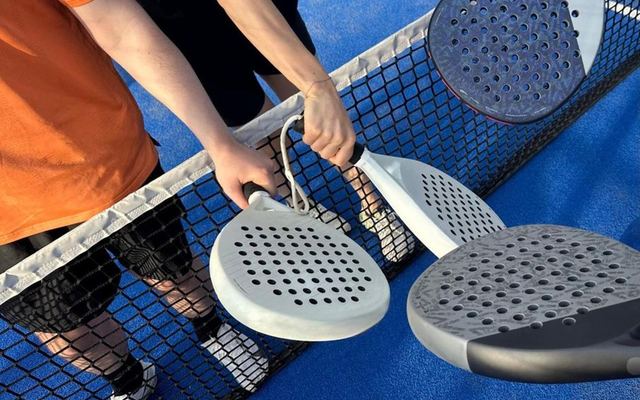 How to Choose a Padel RacketPadel racket size limits from the International Padel Federation (FIP) and brand prices seen in October 2026, from an $84.00 sale model to $399.00.
- Best Padel Racket for Beginners in 2026Padel rackets for beginners that Babolat, Wilson, Nox and Siux label for new players, with printed specs and prices seen on October 8, 2026.
- Padel Balls Explained With Specs and PricesThe International Padel Federation (FIP) size and bounce rules for padel balls, with Babolat and Wilson US prices as seen on October 8, 2026.
- What to Look for in Padel Shoes, With PricesWhat to look for in padel shoes, with Wilson and Babolat outsoles priced $73.50 to $170.00 in October 2026 and Wilson's advice on tennis shoes.