Sports Like Tennis: Racket Sports Compared
Seven racket sports compared with tennis on court, ball and scoring.
Seven racket sports share something with tennis: a racket or paddle, and in some cases tennis-style scoring. Padel, POP Tennis and platform tennis score like tennis; beach tennis, pickleball, racketlon and crossminton change the scoring, the ball or the court. At Wildcard Sport, we research each from the governing-body rulebooks.
Padel and Its Walled Court
Padel keeps tennis-style scoring (LTA). The FIP rulebook sets the court at 65.6 ft by 32.8 ft (20 m by 10 m), fully enclosed by walls and metal fence. Its area is 2,153 sq ft (200 m²), about 77% of a tennis doubles court (derived from the FIP and ITF figures).
The padel net is 34.6 in (0.88 m) high at the center. The ITF tennis net is 3 ft (0.914 m) at the center, so the padel net sits about 1.4 in (3.4 cm) lower (derived). Padel scoring uses the same 15, 30, 40 pattern, with best of three sets and Advantage, Golden Point or Star Point options at deuce, per the FIP rulebook.
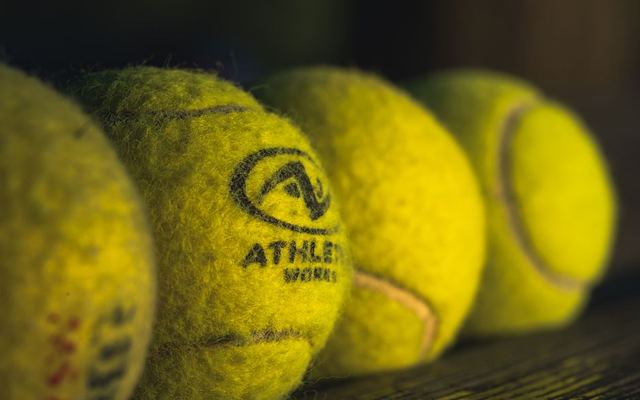
A padel ball measures 2.50 to 2.67 in (6.35 to 6.77 cm) and weighs 1.98 to 2.10 oz (56.0 to 59.4 g). A tennis Type 2 ball measures 2.57 to 2.70 in and weighs 1.975 to 2.095 oz, so the weight ranges nearly match and the size ranges overlap.
The racket differs in several ways. A padel racket is stringless and perforated, up to 17.9 in (45.5 cm) long, with a wrist cord of at most 13.8 in (35 cm). A tennis racket may reach 29.0 in (73.7 cm) and has crossed strings. The padel maximum length is about 62% of the tennis maximum (derived). The FIP rules also require the padel serve to be bounced and struck at or below waist level, with at least one foot on the ground.
The LTA says padel is generally considered easier to learn than tennis. For the rule details, see the padel rules page, the padel court dimensions and the padel rackets guide. The padel vs tennis comparison puts the two sports side by side.
POP Tennis on a Smaller Court
POP Tennis is played on a court 50 ft (15.24 m) long and 20 ft (6.096 m) wide, with a net 31 in (78.74 cm) high at the middle, according to the POP Tennis website. That gives 1,000 sq ft of playing area (derived), about 36% of the tennis doubles court area of 2,808 sq ft (260.8 m²) from the ITF figures (derived).
The paddle has no strings. It replaces them with a perforated strike zone made of fiberglass or carbon fiber. The ball has 50% to 75% of the compression of a standard tennis ball.
Scoring matches tennis: 15, 30, 40, advantage within games, and tie-break sets. The serve differs. The server gets one serve per point, and it must be underarm. POP Tennis keeps the tennis scoring, but it changes the court, the net height, the paddle and the serve.
Platform Tennis Inside a Screen
The American Platform Tennis Association (APTA) rules set the court at 44 ft (13.41 m) long and 20 ft (6.10 m) wide, laid on a deck of 60 ft by 30 ft (18.29 m by 9.14 m). The deck is enclosed by a screen 12 ft (3.66 m) high. The court area is 880 sq ft (derived).
The net is 37 in high at the posts and 34 in at the center. The service line sits 12 ft (3.66 m) from the net. A paddle may be up to 18 in long by 12 in wide and weigh up to about 17.6 oz (500 g). The ball is flocked rubber, 2.4 to 2.5 in across and 2.4 to 2.7 oz. That ball weighs more than the tennis Type 2 range of 1.975 to 2.095 oz and measures less across than the tennis range of 2.57 to 2.70 in.
Scoring is tennis scoring: 15, 30, 40, deuce and advantage, sets to 6 games by 2, and a 7-point tie-break at 6-all. Several rules change the play. The receiving team must let the serve bounce, and volleying it out of the air loses the point (Rule 10d). A ball that bounces on the deck in the correct court and then touches the screen stays in play (Rule 14s). In doubles, only one serve is allowed per point (Rule 9g). Singles uses sidelines 2 ft inside the doubles lines, a court width of 16 ft, two serves, and no-ad scoring (Rule 18).
Platform tennis was created in 1928 in Scarsdale, New York, according to the Platform Tennis Hall of Fame. The governing body was chartered in November 1934 as the American Paddle Tennis Association and renamed the American Platform Tennis Association in 1950. Platform tennis (1928) predates pickleball (1965). APTA says it has over 36,000 members and oversees more than 275 tournaments a year, per platformtennis.org.
For the sport's own page, see platform tennis. The platform tennis vs padel comparison covers the other pairing.
Beach Tennis on Sand
The ITF Rules of Beach Tennis set the doubles court at 52.5 ft (16.0 m) long and 26.2 ft (8.0 m) wide, with singles at 14.8 ft (4.5 m) wide. The doubles area is about 1,378 sq ft (128 m²), a derived figure.
The net is 5 ft 7 in (1.7 m) for women's, mixed and junior events and 5 ft 11 in (1.8 m) for men's events at BT100 and above. The tennis figure for comparison is 3 ft (0.914 m) at the center. The racket has no strings. It may not exceed 19.7 in (50 cm) in length, 10.2 in (26 cm) in head width or 1.5 in (38 mm) in thickness.
The ball is an ITF Stage 2 (orange) low-compression ball. It weighs 1.27 to 1.65 oz (36.0 to 46.9 g) and measures 2.36 to 2.70 in (6.00 to 6.86 cm) across. Its weight sits below the tennis Type 2 range. Each point has one serve (Rule 18).
A standard game is No-Ad, so a single deciding point settles deuce. A match can be best of three sets. At one set all, a 10-point match tie-break with a 2-point margin replaces the third set. Under Rule 24b, a team loses the point when the ball touches the sand on its side.
Beach tennis emerged in Italy in the early 1970s. The ITF recognized it as a discipline from 2010, and it was contested at the 2019 World Beach Games in Qatar, according to this beach tennis history page. The sport's own page is beach tennis, and the beach tennis vs padel comparison sets it against padel.
Pickleball and Its Eleven-Point Games
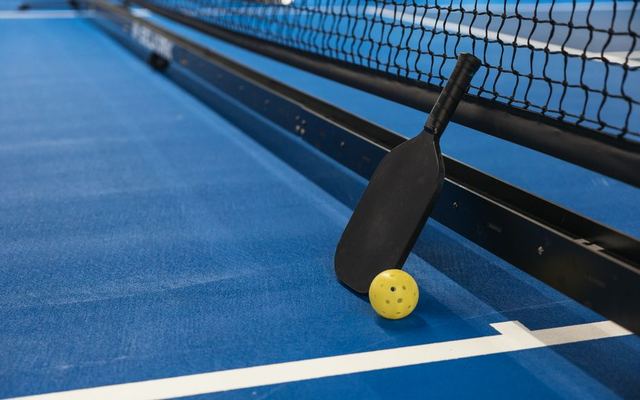
The 2026 USA Pickleball Official Rulebook sets the court at 20 ft (6.10 m) wide and 44 ft (13.41 m) long for both singles and doubles. The area is 880 sq ft (81.8 m²), derived from those dimensions.
The non-volley zone, called the kitchen, is 7 ft (2.13 m) deep on each side of the net and runs 20 ft wide. The net is 36 in high at the sidelines and 34 in at the center, each within 0.25 in of that height. A paddle may have a combined length and width of up to 24 in (60.96 cm) and a length of up to 17 in (43.18 cm). The rulebook sets no limit on thickness or weight. A tennis racket can be 29.0 in (73.7 cm) long.
The serve must be made with an upward arc, the ball no higher than the server's waist, and the paddle head not above the wrist. The two-bounce rule requires the serve and the return of serve to each bounce before being hit. Scoring typically goes to the first side to 11 points, leading by at least 2. Tournament options include best 2 of 3 or 3 of 5 games to 11, all won by two points.
The SFIA reports that 24.3 million Americans played pickleball in 2025, up from 4.2 million participants in 2020. Joel Pritchard, Bill Bell and Barney McCallum invented pickleball in 1965 on Bainbridge Island, Washington, per USA Pickleball.
Related: pickleball vs tennis and sports like pickleball.
Racketlon's Four-Sport Format
The Federation of International Racketlon (FIR) rules set a racketlon match at four sets, one each in table tennis, badminton, squash and tennis. The sets run from the smallest racket to the biggest, so tennis is the last set.
Traditional racketlon uses a running score to 21 points with a 2-point margin, and every rally scores. Team competitions can use a running score to 11, 15 or 21 points. The Racketlon Sprint format runs to 11 points per set, with a golden point at 10-10. Otherwise, racketlon follows the rules of each of the four individual sports.
Crossminton and the Shuttle
The International Crossminton Organisation (ICO) rules describe two opposing squares, each 18.0 ft (5.5 m) per side, set 42.0 ft (12.8 m) apart. The serve line is 9.8 ft (3 m) behind the front line.
The flying device is a shuttle called the Speeder. It weighs 8 to 10 g (0.28 to 0.35 oz) and measures 2.2 to 2.5 in (57 to 63 mm) high. A Type 2 tennis ball weighs 56.0 to 59.4 g. A crossminton racket may not exceed 24.0 in (61 cm) in length or 650 cm² (101 sq in) in head size.
A match is best of three sets, and a set is won at 16 points, with tie-break rules applying. Singles and doubles are both played, and the serve must be made within 30 seconds.
Court, Ball and Rule Differences
The tennis baseline is a court 78 ft (23.77 m) long, a net 3 ft (0.914 m) high at the center, and a Type 2 ball weighing 1.975 to 2.095 oz (56.0 to 59.4 g), per the ITF rules of tennis. The court areas show the scale gap. The ITF figures put a tennis doubles court at 2,808 sq ft (260.8 m²). Padel covers about 77% of that, beach tennis doubles about 49%, POP Tennis about 36%, and pickleball and platform tennis about 31% each. Those percentages are derived from the listed dimensions.
Net heights at the center are 36 in in tennis, 34.6 in in padel, 34 in in pickleball and platform tennis, and 31 in in POP Tennis. Beach tennis uses a taller net, 5 ft 7 in (1.7 m) for women's, mixed and junior events.
Ball weight separates the sports further. The tennis and padel ranges nearly match at 1.98 to 2.10 oz (56.0 to 59.4 g). The beach tennis ball falls to 1.27 to 1.65 oz (36.0 to 46.9 g), and the crossminton shuttle weighs 0.28 to 0.35 oz (8 to 10 g). The platform tennis ball, at 2.4 to 2.7 oz, weighs more than the tennis range.
Serve and bounce rules also differ. Padel's serve must bounce and be struck at or below waist level. Pickleball requires the serve to be made with an upward arc and the ball no higher than the waist, and it applies the two-bounce rule. Platform tennis requires the receiving team to let the serve bounce. Beach tennis allows one serve per point, and POP Tennis allows one underarm serve per point.
Summary Table of the Seven Sports
| Sport | Court or area | Net at center | Scoring | Racket or paddle | Ball |
|---|---|---|---|---|---|
| Tennis (reference) | 78 ft long; 36 ft wide for doubles; 2,808 sq ft doubles (derived) | 3 ft (0.914 m) | Points score the same as padel (LTA) | Strung, up to 29.0 in (73.7 cm) | 1.975 to 2.095 oz (56.0 to 59.4 g), Type 2 |
| Padel | 65.6 by 32.8 ft (20 by 10 m), enclosed; 2,153 sq ft (200 m²) | 34.6 in (0.88 m) | 15, 30, 40; best of 3 sets | Stringless, up to 17.9 in (45.5 cm) | 1.98 to 2.10 oz (56.0 to 59.4 g) |
| POP Tennis | 50 by 20 ft (15.24 by 6.096 m); 1,000 sq ft (derived) | 31 in (78.74 cm) | Tennis scoring; underarm serve, one per point | Perforated strike zone, no strings | 50% to 75% of a standard tennis ball's compression |
| Platform tennis | 44 by 20 ft (13.41 by 6.10 m) inside a 60 by 30 ft deck; 880 sq ft (derived) | 34 in | Tennis scoring; 7-point tie-break at 6-all | Up to 18 by 12 in; up to 17.6 oz (500 g) | Flocked rubber, 2.4 to 2.5 in; 2.4 to 2.7 oz |
| Beach tennis | 52.5 by 26.2 ft (16.0 by 8.0 m) doubles; 1,378 sq ft (128 m²) | 5 ft 7 in (1.7 m) for women's, mixed and junior | No-Ad standard game; 10-point match tie-break | Unstrung, up to 19.7 in (50 cm) | Stage 2, 1.27 to 1.65 oz (36.0 to 46.9 g) |
| Pickleball | 44 by 20 ft (13.41 by 6.10 m); 880 sq ft (81.8 m²) | 34 in, within 0.25 in | Typically first to 11, leading by 2 | Combined length and width up to 24 in (60.96 cm) | Ball specs: USA Pickleball rulebook |
| Racketlon | Uses the court of each of its four sports | Set by each sport's rules | Running score to 21 (traditional) | Set by each sport's rules | Set by each sport's rules |
| Crossminton | Two squares, 18.0 ft (5.5 m) per side, 42.0 ft (12.8 m) apart | Two squares (ICO court description) | Sets won at 16 points; best of 3 | Up to 24.0 in (61 cm) long | Shuttle, 0.28 to 0.35 oz (8 to 10 g) |
Participation Figures
Three publishers report 2025 participation figures for sports on this page. The USTA reports 27.3 million tennis players in the United States. The United States Padel Association reports 1,073,000 Americans who played padel in 2025. The SFIA reports 24.3 million pickleball players.
How to Choose
- Pick padel if you want tennis scoring, a ball close in weight to the tennis ball, and walls around the court.
- Pick POP Tennis if you want tennis scoring on a 50 by 20 ft (15.24 by 6.096 m) court with a stringless paddle. Skip it if you need the standard tennis ball's compression, because the POP ball has 50% to 75% of that compression.
- Pick platform tennis if you want tennis scoring inside a 12 ft (3.66 m) screen and can use a ball weighing 2.4 to 2.7 oz. Skip it if you want a ball in the tennis weight range.
- Pick beach tennis if you want a net game on sand with No-Ad games and one serve per point. Skip it if you need the tennis court or ball sizes, since the beach court and ball differ.
- Pick pickleball if you want 11-point games on a court of 880 sq ft (81.8 m²).
- Pick racketlon if you want tennis as one of four sets in a single match.
- Pick crossminton if you want a shuttle on a two-square court.
Still undecided? Try the new sport quiz. See the padel vs tennis comparison.
Frequently Asked Questions
What Do These Sports Share With Tennis?
It depends on what you measure. Padel's ball weighs 1.98 to 2.10 oz (56.0 to 59.4 g), nearly the same as the tennis Type 2 range in the ITF rules. Padel, POP Tennis and platform tennis all use tennis-style scoring. The LTA states that padel and tennis score points the same way.
Is Padel Easier to Learn Than Tennis?
The LTA says padel is generally considered easier to learn than tennis.
Can You Use a Tennis Racket for Padel?
A strung tennis racket does not fit the FIP racket description. The FIP rules describe a stringless, perforated racket up to 17.9 in (45.5 cm) long. A tennis racket is strung with crossed strings and may be up to 29.0 in (73.7 cm) long under the ITF rules.
Is Tennis the Same as Pickleball?
No. A pickleball court is 880 sq ft (81.8 m²), and a tennis doubles court is 2,808 sq ft (260.8 m²), both figures derived from listed dimensions. Pickleball games typically run to 11 points, while the LTA says tennis and padel score points the same way.
Which of These Sports Have the Smallest Courts?
Pickleball and platform tennis each have a playing area of 880 sq ft (each derived from 20 ft by 44 ft), smaller than POP Tennis at 1,000 sq ft (derived) and beach tennis doubles at 1,378 sq ft (128 m²). Crossminton is described as two 18.0 ft squares 42.0 ft apart, so its area is not comparable.
How Many People Play Tennis Compared With Padel?
The USTA reported 27.3 million tennis players in the United States in 2025. The United States Padel Association reported 1,073,000 Americans who played padel in 2025. The two figures come from different publishers.
Sources
- ITF Rules of Tennis 2026
- FIP Rules of Padel
- LTA: Padel vs Tennis
- POP Tennis
- APTA Official Rules
- APTA, platformtennis.org
- Platform Tennis Hall of Fame: The Founders
- Platform Tennis Hall of Fame: Founding of the American Paddle Tennis Association
- ITF Rules of Beach Tennis
- Beach tennis history
- 2026 USA Pickleball Official Rulebook
- USA Pickleball: What Is Pickleball
- SFIA participation report
- FIR Rules of Racketlon
- ICO Rules of Crossminton
- USTA participation report
- United States Padel Association: one million players
Try a Free Tool
More From Compare
 Padel vs Pickleball: The Key Differences
 Sports Like Pickleball, Compared by Rules
 Padel vs Tennis: The Key Differences
 Pickleball vs Tennis: The Key Differences
 Padel Ball vs Tennis Ball: What's Different
- Platform Tennis vs Padel Compared Side by Side
- Flag Football vs Tackle Football Rules Compared
- Roundnet vs Spikeball Rule Differences